

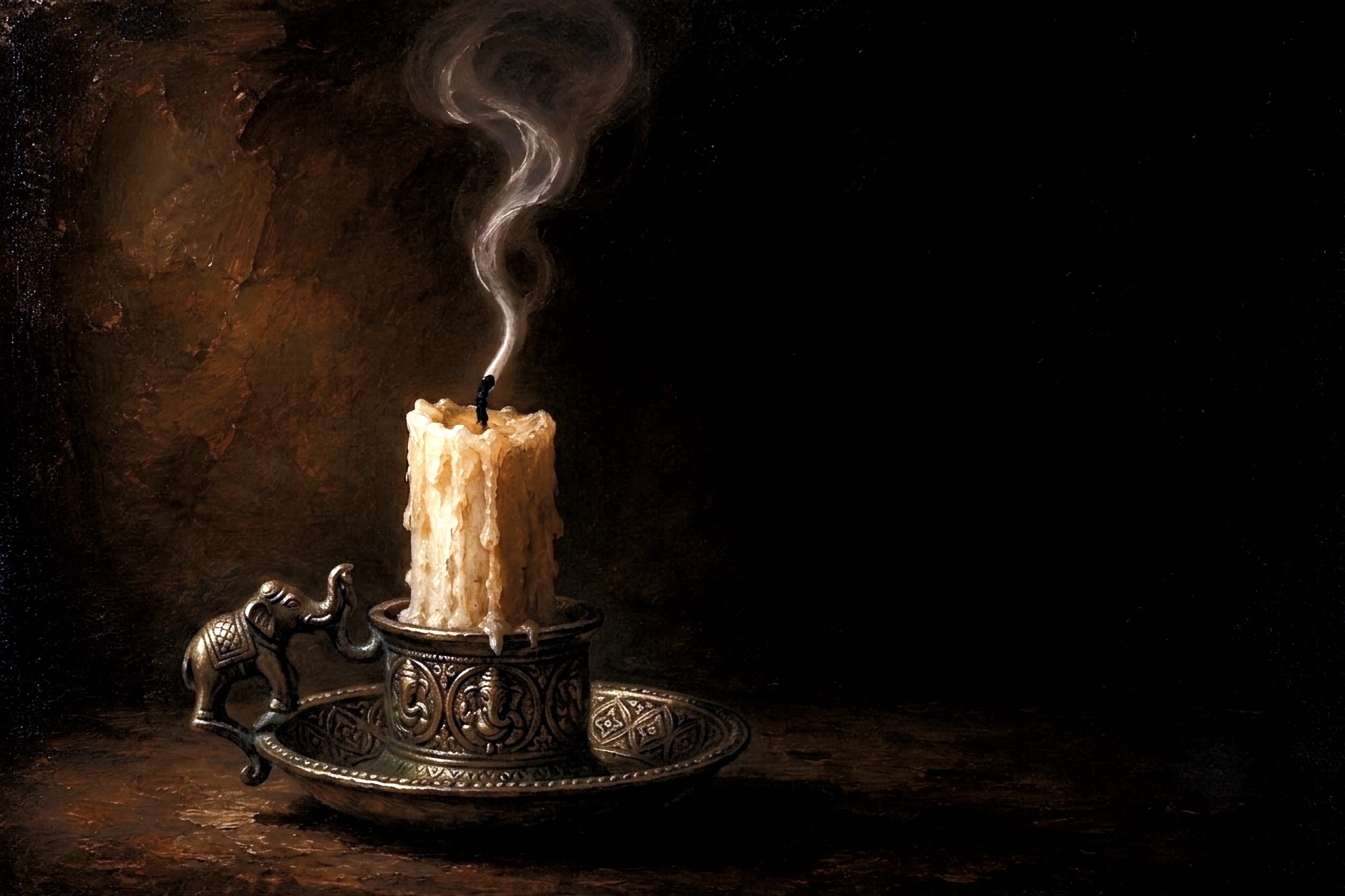
There are days when you know you cannot trust your own judgment.
The inward light flickers out, intuition goes silent, and even the feelings you reach for when reason fails seem just beyond reach.
This may be familiar terrain, along with the pattern that sometimes emerges from it.
We are taught to push through it. To ignore what rises. To answer the call, to keep the schedule, to stick to the plan. Because the job, the calendar, the world, and the planets do not pause for what we cannot yet recognize.
Yet in the dim hours of an eclipse, something stirs. Something you set aside long ago, believing it was finished with you—or you with it—rises without warning.
And still some primordial instinct quietly urges stillness, because a choice made in darkness rarely stands the test of morning light.
Light Extinguished
Eclipses, Rahu, Ketu & the Shadow Within
For as long as humans have looked up at the sky, the two luminaries have kept their rhythm without fail. The Sun rises and sets each day, its light lengthening toward summer and receding in winter. The Moon moves through its own ordered cycle, brightening to full, waning to dark, and returning to full once more in a synodic cycle of about 29.5 days.
About four times a year, and sometimes more, the two luminaries that order our days and nights are eclipsed. The Sun darkens, or becomes a ring of fire around a black center, and the full Moon turns the color of rust and old blood.
The ancient rishis who preserved the system of Jyotish watched this same sky. Without telescopes or advanced technological instruments, they passed on centuries of careful observation and teachings, and a way of reading the heavens as a sacred language.
When the luminaries shifted from their expected rhythm or appeared altered, the ancient seers of Jyotish took careful note, especially in an era when astrology and omens served kings and kingdoms long before natal astrology became widespread.
These breaks in the sky’s dependable rhythm were always considered consequential, and their significance continues to echo through the tradition of Jyotish thousands of years later.
Eclipse season is just ahead in August. Whether you are new to observing eclipse patterns in the birth chart, or have followed them for years, I thought it might be interesting to view them through an additional lens before releasing the August eclipse analysis.
The weight of an eclipse becomes clearer when we deeply connect with what the Sun and Moon represent within us and how their symbolism speaks to the Shadow archetype in Jungian thought.
Svarbhanu and the Stolen Nectar
Astronomy explains how an eclipse occurs. Vedic mythology explains why the tradition treats eclipses with such gravity.
The gods and the asuras churned the cosmic ocean for amṛta, the nectar of immortality, using the great serpent Vasuki as the churning rope. When the amṛta finally rose to the surface, a struggle broke out over who would be allowed to drink it. Vishnu took the form of Mohini, an enchantress of such extraordinary beauty that she could move through the gathering and distribute the nectar by her own design, to the gods alone.
One asura, Svarbhanu, noticed the deception. Using his illusory powers, he changed his appearance, slipped into the ranks of the gods, and tasted a drop of the amṛta before he could be stopped.
Surya and Chandra, the Sun and the Moon, recognized him and called him out. Mohini turned and severed his head with the Sudarshana chakra before the nectar could slip completely down Svarbhanu’s throat. But by then it was too late for death to take him. The head had already tasted immortality, and so had the body, and neither could die.
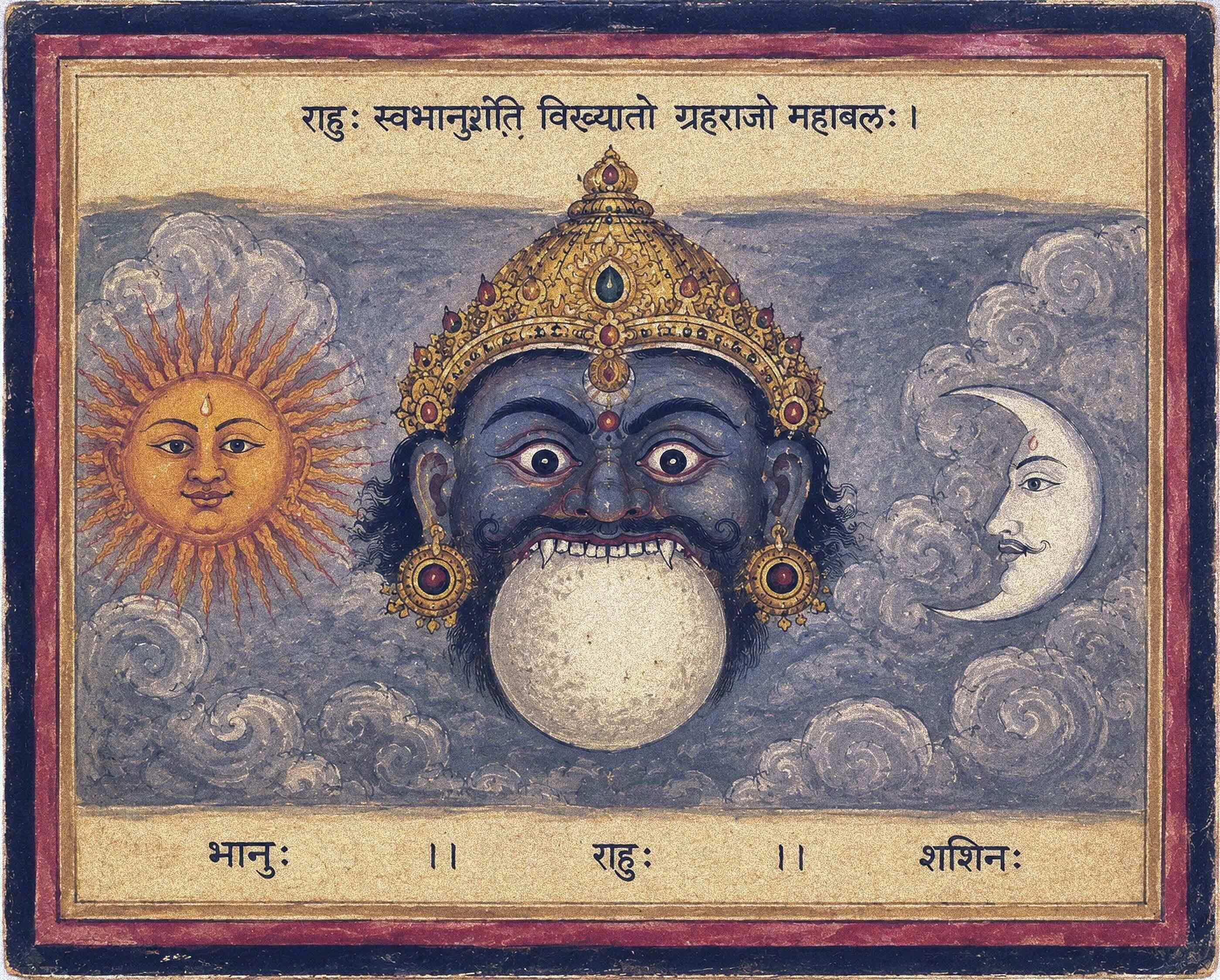
So they became immortal in two parts. The head became Rahu. The body became Ketu.
They have pursued the two luminaries ever since, in revenge for the betrayal, perpetually moving backward against the grain of the sky, eternally hungry. When either Rahu or Ketu catches the Sun or the Moon and swallows it, their light is extinguished temporarily, and the world as we know it experiences an eclipse.
This is the image the tradition asks us to hold: the luminaries are not merely shadowed by geometry. They are devoured, briefly, by the part of the cosmos that drank immortality without earning it. The positions of Rahu and Ketu in the chart describe places of distortion, compulsion, release, and karmic pressure.
A Jungian Parallel
Before going further, it may help to be clear about the approach taken here. My intention is to place Jyotish and Jungian thought in conversation, each with its own language and integrity. Both point, in different ways, toward the enduring mystery of how unconscious forces shape human life.
My perspective comes primarily through the lens of Jyotish, alongside my own years of study and personal experience with Jungian analysis. I offer these reflections as a Jyotish practitioner and a student of Jung's work rather than as a Jungian scholar, exploring where these two symbolic languages illuminate similar aspects of the human experience.
With that distinction in mind, we can now look at where the symbolism of Rahu and Ketu runs alongside themes explored in Jungian psychology.
Svarbhanu’s myth rhymes with a core Jungian insight: when an unintegrated, autonomous drive hijacks the conscious psyche to identify with archetypal power before the personality is ready, a violent psychological split occurs. By taking the nectar without earning his place among the gods, Svarbhanu overreaches. The result is a profound psychological division. A once unified instinctual force becomes split into two autonomous tendencies that operate largely outside conscious awareness.
Rahu resembles one expression of the Jungian Shadow, the part of us that carries what has not yet been consciously integrated, including desires, impulses, and potentials we have not fully recognized. Ketu resembles the deeply conditioned side of the psyche, where old patterns continue long after they have ceased to serve us.
Together they form a single archetypal image: two halves of the same unconscious force that can only be transformed through conscious awareness and balance.
Jung did not write about Rahu or Ketu, nor does Jyotish describe the psyche in Jungian terms. Yet the symbolic language of these two traditions often points toward remarkably similar psychological realities. Read together, they offer two complementary ways of understanding the movements of the unconscious and the work of integration.
“One does not become enlightened by imagining figures of light, but by making the darkness conscious.” — C. G. Jung, “The Philosophical Tree,” Alchemical Studies (CW 13, ¶335)
The Radiant Self and the Reflective Mind
The Sun represents Ātman, the radiant center of being. In Jungian psychology, the closest parallel is the archetype of the Self, the central organizing principle of the total psyche and the source of vitality around which conscious life coheres.
The Moon represents Manas, the reflective, emotional mind; in Jung’s framework, its closest psychological analogue is the feeling life of the personal unconscious and the instinctual psyche. Like the Moon itself, this matrix reflects the light of the deeper Self, translating raw psychic energy into felt experience.
Since an eclipse temporarily veils both luminaries, it obscures both the ordering light of the Self and the receptive clarity of the feeling mind. The tradition understood these moments as times when our usual sources of clarity are not available. They are moments that invite reflection rather than certainty.
The Head and Body of the Chāyā Grahas
The two shadow planets, the north and south nodes of the Moon, are worth revisiting whether you are new to Jyotish or simply ready for a refresher.
Eclipses are the moments when the chāyā grahas, Rahu and Ketu, can surface the psychological material that Jung later described through the concept of the Shadow. The steady presence of the Sun and Moon ordinarily holds this material below the threshold of awareness, much as the Sun’s glare hides the stars at midday.
What rises during an eclipse has been present all along, emerging only when the light of the luminaries briefly withdraws. The integration work happens once the light returns, when Ātman and Manas can turn toward what has risen.
Any planet in the birth chart can be associated with shadow work in Jungian thought. The nodes play a unique role: their placement marks the karmic axis of the chart. Eclipses also activate the transiting karmic axis, creating a dynamic tension within the birth chart.
Rahu Consumes
Rahu is the head. He swallows, and to consume is the sum of his nature, although he has no throat, body, or stomach to retain what he attempts to take in. He is always hungry as a result. Viewed through a Jungian lens, Rahu symbolizes the psyche’s restless search for completion, forever believing that fulfillment lies just beyond the next achievement, possession, relationship, or revelation.
The light he catches passes straight through the severed neck and returns to the sky, which is why every eclipse ends with the Sun and Moon returning.
The house where Rahu resides in the birth chart marks the part of our lives where we reach for more and more, remaining unfulfilled regardless of accomplishment. It carries an almost visceral desire. He represents obsession, illusion (māyā), and radical projection. He is the hunger of the serpent who tasted immortality but could not hold onto it.
When Rahu is strong or angular in the chart, we may project our power or desires, which are not yet integrated, onto others, seeing them as wildly fascinating or intensely destabilizing. The door to Shadow integration opens through this portal, and we can be overtaken by it unless we learn to make a place for the hunger without letting it consume us. Rahu’s placement in the chart often points to where desire intensifies faster than discernment can keep pace.
Ketu Releases
Ketu is the body. He is the part of the serpent who lost the head he once answered to, moving through the sky without eyes to find his way. In a chart, he marks where the mind has already loosened its grip, where attachment has thinned to almost nothing. What remains is direction without a compass or an appetite.
Ketu evokes those deeply ingrained psychological patterns that have become so habitual they operate almost entirely outside conscious awareness. They can function like old defenses, repeating themselves long after their original purpose has been forgotten.
When unconscious, Ketu can manifest as apathy, withdrawal, or a sense of disconnection. Yet in Jyotish his deeper significance reaches beyond psychology. Ketu marks the places where worldly attachment has already begun to loosen, inviting surrender rather than acquisition.
While Rahu binds us to the unfinished work of desire, Ketu quietly points toward release, making him one of the chart’s primary indicators of spiritual awakening and ultimately, mokṣa.
The Mechanism Beneath the Myth
When the Sun, Moon, and Earth fall into a single line, one body interrupts the light and a shadow crosses the face of another. During a solar eclipse, the Moon slips between the Earth and the Sun, casting a narrow shadow across our world. During a lunar eclipse, the Earth moves between the Sun and the Moon, cutting off the Moon’s borrowed light and turning it the color of rust.
Astronomically, Rahu and Ketu are the lunar nodes, the two points where the Moon’s orbital path crosses the plane of the Earth’s orbit around the Sun. Eclipses occur only when a new or full Moon falls at one of these intersection points. The myth and the geometry describe the same two points in the sky.
Many learned Jyotish scholars hold that an eclipse is felt most strongly where it is visible. My own experience, and that of many clients, suggests the influence can reach far beyond the path of visibility, a reminder of how deeply we are woven into a cosmos we are only beginning to measure.
When the luminaries are eclipsed, and when planets are caught within the eclipse field, especially if they are in the same sign where the eclipse occurs, their indications become obscured. The usual clarity of their expression is temporarily disturbed. The foundational meanings of the houses these planets rule are cast into shadow, shifting the ground beneath our feet.
Moving Through an Eclipse Season
Tradition is practical about eclipses, and the counsel of the ancient sages has held for thousands of years.
Because the luminaries are obscured, the best option is to delay decisions of real consequence until the light of the Sun or the Moon returns. When the lights are swallowed, discernment is easily disturbed and difficult to trust.
The mind that would normally weigh a choice is working in shadow, and what looks clear during an eclipse often reads differently a few weeks later. Sometimes new information emerges that would have changed the decision entirely.
Eclipse season is roughly two weeks before the first eclipse through two weeks after the last, and the whole window is better suited to reflection than to new beginnings. It is a time for turning inward, for watching what surfaces, and for waiting. Important new ventures are best delayed until the light is steady again.
The unsettled quality reaches into the body as well, which is one reason the tradition treats eclipse time as a period for caution rather than trying to push through. This is a time to favor conservative actions in physical activities and to let the more extreme adventures wait. When possible, elective procedures are best scheduled outside the eclipse window, though care that is genuinely needed should always come first, regardless of the sky.
Spiritual practice, by contrast, is amplified. Mantra, japa, and meditation carry unusual potency during an eclipse, and the tradition treats these days as fertile ground for inner work. If you keep a journal, eclipse season rewards this process; what surfaces during these times often names itself more clearly on paper than in the mind.
Traditionally, the rishis also advised against directly watching an eclipse. For a solar eclipse, this aligns with modern understanding of eye safety. Within the symbolic framework of Jyotish, the teaching carries another meaning as well: what we take in through the eyes is considered a form of participation, and even ingestion.
If the felt side of this is what draws you, the way an eclipse moves through the body and the nervous system in particular, I gave that its full attention in a companion piece, When the Shadows Reveal the Fault Lines. This essay stays with the foundation. That one stays with the body.
Held together, these instructions form a way of aligning with the rhythm of the moment. The light withdraws so that we will look in a different direction.
Eclipse Season Ahead: August 2026
August features a total solar eclipse on August 12 and a partial lunar eclipse overnight August 27–28. Each event carries its own signature within Cancer and the Leo-Aquarius axis, and I will take them up one at a time in the articles that follow the monthly guide in early August. For now, it is enough to understand why the tradition treats the swallowing of the light with such care, and how to hold yourself steady while it passes.
The focused eclipse articles will build on this foundation.
From my research desk
I have been fascinated by Carl Jung and his work for well over a decade, and I have worked with a Jungian analyst for many years. My relationship with Jung's work has been one of ongoing study, reflection, and personal exploration rather than academic specialization. Much of what I write about the Shadow, the unconscious, and the work of integration has been shaped by study and by the slow, steady process of sitting with these themes in my own psyche.
Jung himself grew increasingly interested in Eastern traditions in the second half of his career, writing the psychological commentary for Richard Wilhelm's translation of The Secret of the Golden Flower, a Taoist text. That dialogue between Eastern wisdom and depth psychology became an enduring thread in his later work.
My hope is that this conversation opens a doorway for readers to explore both traditions more deeply, each on its own terms.
For those unfamiliar with Jung, or those who would like to go further, the podcast Speaking of Jung, hosted by Laura London, is excellent. She interviews Jungian analysts from around the world, offering thoughtful discussions that bring Jung’s ideas to life.
If Jung’s work resonates and you feel drawn to explore this path directly, Jungian Online connects people with trained Jungian analysts and depth-oriented therapists from across the globe, making this kind of work available beyond the traditional limits of geography.
The light withdraws twice in August. The August guide and the full analysis of each eclipse will reach you as they publish.
Wow! Amazing read x
Just found your page and I love your writing and knowledge, thanks for sharing :)